Three approaches to the impending warming of the globe’s climate emerged after reviewing the applications for this year’s Buckminster Fuller Challenge award – a $100,000 grant with no strings attached. The recipient is a pragmatic visionary who fulfills Bucky’s holistic world view and confirms his faith in human ingenuity. Serving as one of six jurors provided a rare glimpse at problem-solving innovations that are capable of planet-wide impact.
None displayed the public’s prevailing response to predictions of climate change – DISREGARD. Some were pro-active. Others were re-active. But all were active.
Since categorizations reflect entrenched cultural values, the significance of the conference reported in this blog lies far beyond intellectual curiosity and mental antics. Instead, it delves into the core values that define the ecological, economic, political, religious, and social practices that distinguish the contemporary era.
The symposium in question was co-organized by Terike Haapoja for the current Venice Biennale. It is titled it “A Counter Order of Things”. The ‘counter order’ refers to the search for alternatives to the Linnaeus tree of taxonomical knowledge that has long ruled the biological sciences.
The phrase is also a rif on Michel Foucault whose seminal book is entitled The Order of Things. Written in the 1960s, it asserts the limitations of standard taxonomies. Foucault replaces the reasoned order that accounts for Linneaus’s renown with a new system of thought that he calls the “exotic charm” that comprises a basis for post-modernist thought.
As proof that artists who are activists regarding environmental reform also tend to exhibit a fervent desire to reform social spaces as well. They apply the terms ‘safe’, ‘true’, ‘clean’, ‘sustainable’, and ‘productive’ to multiple contexts. Consider the Experiments in Extra-Institutional Education that Michael Mandiberg organized with several collaborators.
Last spring he organized a colloquium exploring experiments in educational stratagies and philosophies. The project gathered the prime-movers whose creativity is inspired by the objection to schools in which desks are lined up in rows, bells regulate the march of students through halls, and classroom content is dictated by remote authorities.
The popularity of the initial event has spawned this autumn’s Experiments in Extra-Institutional Education seminar series. 
A life-ambition was fulfilled last weekend when I visited Herbert Bayer‘s renowned Mill Creek Earthworks Project for the first time. While every description mentions its location at the confluence of two rivers, none reveal that it is also situated in the confluence of several highways. They literally exist as ‘high’ ways because this renowned water restoration project lies far below the thoroughfares on two sides, an apartment complex on the third side, and a distant view of the town on the fourth. The pure shapes of a refined artistic sensibility exist in the midst of ceaseless traffic and banal architecture.


What shall we name the current epoch?
There is a consensus within the International Union of Geological Sciences, the organization that determines the naming of eras. It asserts that the Holocene epoch is over (it lasted for almost 12,000 years). Yet this consensus has not averted a contentious debate that pits scientists against environmentalists regarding the choice of a new name.
Strife surrounds the leading name candidate – “The Anthropocene Era”. The term derives from ‘anthropo’, for human, and ‘cene’, for new.
What is new about humans?
The answer inferred by the term ‘anthropocene’ is the impact of human life upon the globe. But, you might protest, human impact can be traced back to A.D. 900 when agriculturists began to leave their marks upon the planet. The justification is that someting significant IS new. It is the nature and the intensity of this impact. As a species, humans are now causing mass extinctions of plants and animals, polluting the waterways and the atmosphere, eroding topsoil, causing habitat loss and species invasions, depleting resources, and wreaking havoc on the Earth’s material and energetic systems in countless other ways.
Globalism is apparent in world music, world cups, world wars, world politics, world premieres, world travelers, and the World Wide Web. It is less apparent in paperclips, shoe laces, peanuts, and combs.How can art portray the Earth as an elaborate, synchronized, self-regulating feedback mechanism? How can artists depict the global impact of local behaviors?
This complex scenario if revealed in a work entitled Herbarium of Origins (2006) by the Danish artist, Tue Greenfort. Greenfort focuses on the global consequences that accompany international trade by pairing an intended benefit (the importation of exotic fruits) with an unintended disadvantage (the introduction of invasive weeds).
12.00 Normal 0 false false false EN-US X-NONE X-NONE The positive outcomes that emerge from artistic failures is the focus of the essay in TO LIFE! exploring the work of two esteemed eco artists, Helen and Newton Harrison. The ‘failed’ works under consideration were all created in the 1970s. These renowned artists have continued to produce failed projects ever since. In a recent interview in Leaf Litter, an on-line newsletter published by Biohabitats,, they discuss the paradoxical relationship between artistic success and failure.
Newton states unequivocally, “I’m going to take issue with the whole idea of measuring success. I think it’s stupid.”
He and Helen explain that their relationship with ‘success’ is unconventional because it is unrelated to personal recognition or fame, “The work “works” when the community with whom we’re working understands the work and takes it up…It becomes the work of the community….When the community takes up the work, and the work is big enough, then our name is lost.”
 Helen and Newton Harrison – Sava River
on Sunday, 15 September, 2013. Posted in
ArtistsThe innumerable admirers of Andy Goldsworthy are often baffled by the fact that his work provokes the ire and disdain of many eco artists. May I suggest that a primary reason that his work is problematic involves his futile attempt to unite two incompatable states of nature: wildness (of the sites in which he constructs his artworks( and cultivation (the formal control he asserts over the wild elements). The following provides a historic context for this controversy….
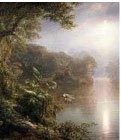
Frederic Church, (The River of Light), 1877 Vhttp://commons.wikimedia.org/wiki/File:El_Rio_de_Luz_%28The_River_of_Light%29_Frederic_Edwin_Church.jpg
“The very freedom to tell gives art enormous power.“
This provocative sentence appears in the current issue of the Brooklyn Rail. It was written by the artist, Lenore Malen, in response to a pithy question posed by guest editor, Carter Ratcliff. He asked, “What Is Art?“
What is art? Malen writes, “Useless, an empty signifier, but also the currency for global capital and high stakes gambling, of great value and interest to millions of people who wait patiently in extremely long lines, and completely irrelevant to countless others…”
on Saturday, 7 September, 2013. Posted in
Artists,
BlogThe planned expansion of the Bündner Kunstmuseum was exploited by Gerda Steiner and Jorg Lenzlinger as an opportunity to radically abandon museum installation protocols by filling the entire building with plants and crystals that will constantly change, undergoing their natural cycles of growth, death, and decay. The project opened on the longest day of the year and will close on the shortest. In between the wonderland the artists created will go wild!

Bundner Kunstmuseum

Steiner/Lenzlinger: National Park
The artist duo has redesigned the building from the basement up to the gables. The fixtures were torn out and used to build a mountain landscape. The rain water that falls on the roof is diverted and used to form streams inside the building. The windows are opened to allow sun, wind and rain to enter the architectural facility. An array of crops have been planted. They are attracting many kinds of animals.