Artist Andy Gracie is expanding the outer reach of his futuristic explorations by attempting to breed a strain of fruit fly that could survive on Titan, Saturn’s largest moon. The first stage of his work, The Quest for Drosophila Titanus.
Gracie chose the fruit fly because it is one of the most thoroughly researched organisms in biology. Thus, it offers two advantages:
One – so many experiments have utilized this organism that it is possibly the most ‘known’ of any living creature.
Two – Humans share such a huge percentage of our genome with the fruit fly that these tiny organisms provide clues to human capabilities.
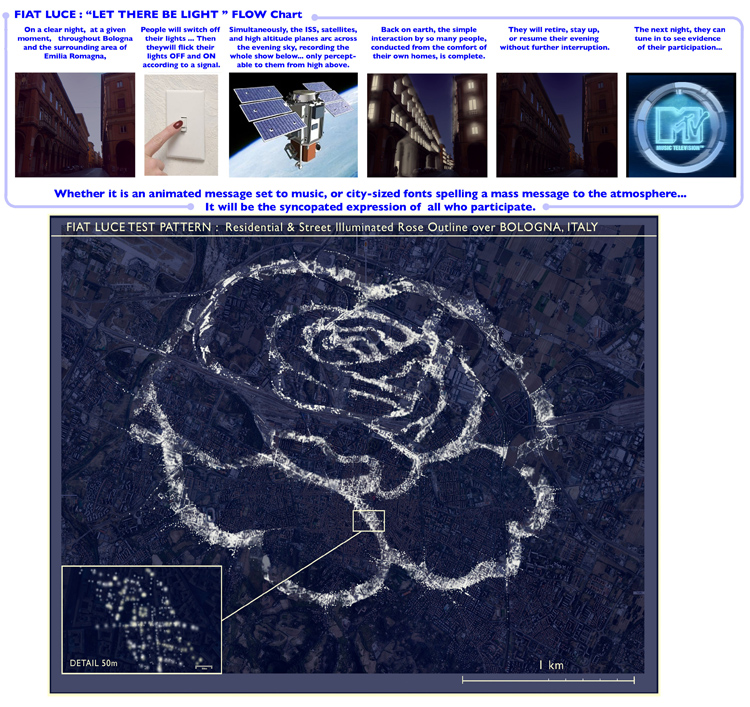
Gaia evokes an image of a world united in peace and activated by sharing and cooperation. Mel Chin has conceived of a work that may not produce a world peace, but it will make ‘sharing’ and ‘cooperation’ a reality for thousands of individuals. Entitled “FIAT LUCE: Let There Be Light”, the work is currently in the form of a proposal prepared in response to a competition for Bologna, Italy public art. His proposal demonstrates, once again, Chin’s devotion to producing a public good instead of a personal feat. It shares the inclusive and uplifting elements that distinguish his Fundred Dollar project.
Mierle Laderman Ukeles has lived long enough to see her children grow up and leave home. The same process is taking place regarding the innovative ‘maintenance’ art she introduced forty years ago. While Ukeles remains the dynamic an art maverick she was, she now enjoys the company of younger female artists like Lillian Ball who are expanding and enriching the feminist perspective on environmental remediation that Ukeles introduced in the 70s.
Establishing continuity among entities that are typically presented as contrasting disparities is the principle inspiring Terike Haapoja. In an effort to establish rapport and cooperation, Haapoja dissolves the contrast between ‘alive’ and ‘dead’, for example, by displaying the gradual morphing that occurs when an entity is no longer supported by breath and metabolism. Furthermore, she erases the boundaries between human life and bacterial life, highlighting the neglected interdependency that fuels the engines of all forms of life. 
An article in today’s NY Times by Edward Hoagland introduces an ironic twist to this theme. Hoagland points out how many popular phrases and adjectives in the language suggest the correlation between homo sapiens and other kinds of animals, “By our own account we’re pigs, yet bearish, owly but mousy, catty and bovine. We beaver at work, hawk merchandise, and ape others by parroting them. We’re lemmings, wolfish, snakes in the grass, weasels, bucks, hens, leonine or sharks. We’re beaky or tigerish, doe-eyed, raven-haired, foxy, chicken-hearted, slow as a tortoise, meek as a dove, sheepish, dogged, old goats, goosey, sitting ducks or vultures. We butt in, bull ahead, change our stripes or spots, strut like a peacock, weep crocodile tears, ram through or swan about. We’re rabbity, calf-eyed, we beat our chests like gorillas, buzz off, or act like a jellyfish.”
Contemporary eco art is a living phenomenon, which means it is responsive, capricious, unpredictable, and evolving. Manifold creative opportunities are available to contemporary eco artists. Such liberties are matched by the creative opportunities available to eco art historians (writers, critics, curators, and instructors). Yet this exhilerating freedom hardly seems conducive to a disciplined scrutiny required of those who engage in art history, a branch of knowledge that records and explains past events.
But we eco art historians are impatient to construct the history of our era. We often begin this task the instant a work of art is presented to the public. Conducting this process in the absence of formulated theories and identified qualifiers is essentially a creative act. Like contemporary artists, contemporary art historians have been emancipated from the confining rules of established orthodoxies.
Subway rats are adding a new dimension to the definition of ‘foody’. These nuisance rodents have defied previous poisons and traps set by transit officials. According to an article headlined, “MTA Sets New Tactic In Rat Wart”, rats are ‘foodies’ who are also locavores’. The current extermination tactic is to offer bait laced with birth control medications. This approach has been successful elsewhere, but it has been difficult in New York.
Devising a tempting bait has revealed that city rats have sophsticated regional palates. Rats in Laos like coconut, which did not appeal to rats in Indonesia that prefer fish. What tempts rats in New York city?
Officials are trying food from their regional diets – trash that contains pizza crusts, cold French fries, and the remains of Chinese take-out. The experiment on the rats’ favorite Manhattan trash recipe is being funded by that the National Institutes of Health. It allocated $1 million to finance rodent taste tests in NYC subway trash rooms. Preliminary findings: rats prefer pepperoni and chicken nuggets.
Nations provide solidarity, protection, and security. But they also produce disputes, dangers, and difficulties. The entities that are currently passing freely across national borders includes toxic heavy metals from mining operations that travel downstream as far as the waters flow; airborne pollutants from coal-fired installations that ride air currents that encircle the globe; crude oil spilled from tankers that travels up the food chain to lodge in the cells of fish that swim the seas; plastic debris that is washed from shores of one continent to arrive on the shores of another; radioactive wastes with half-lives that outlast disposal technologies intended to prevent leakage; GMO crops that escape the confines of an agricultural site by self-propagating.
While no fortification is capable of preventing endangering leakages, the futility of sealing borders is advantageous when benign and beneficial trespassers cross border patrols unimpeded.
We are culturally inclined to replace the encounters that enabled humans to survive for tens of thousands of years in favor of advanced detection gadgetry, complex analytic formulas, and sophisticated simulation programs. Our conclusions are no longer based upon experience of each entity’s unique combination of temperature, weight, texture, smell, size, and sound.
Until this week, it seemed that such intimate interactions with our planet’s animate and inanimate entities had been discarded as crude and outmoded forms of exploration. Then I read an article about mining in South Africa with the headline, “Mining Firms Discover Old-Timers Can Be Worth Their Weight in Gold”.
Algae have just been assigned a new task to fulfill the shared mission of many of today’s designers, engineers, and architects to find an abundant, cheap, non-polluting way to generate energy. Amy Franceschini already enlisted algae in her pioneering explorations to split the bond between oxygen and hydrogen in water molecules in order to release hydrogen, the ultimate energy panacae. Now, algae have been summoned by Splitterwerk Architects to produce their new building’s energy supply, bypassing such conventional alternatives as solar and wind that continue to frustrate large-scale applications.

Environmentalism does not need to engage with eco-terrorists by represent a radical culture-shifting enterprise. Even those who contribute to the movement by such humble acts ad gathering litter or planting tomatoes are disruptive forces. That is because environmental concerns for the well-being of the planet dislodge our culture’s pursuit of ‘self-interest’, ‘self-fulfillment’, and ‘self-expression’. Such entrenched attitudes currently define most peoples’ identity and establish their aspirations.