“Immortal Plastics” is part of a larger body of work by Marina Zurkow entitled “Necrocracy” (necro = dead, ocracy = governemnt). It consists of animations, prints, sculptures, a book, and food tasting events all geared to induce consumers to confront their personal relationships with hydrocarbons.

Eco artists are engaged in emergency rescue missions to save the beleagured planet. Most of these artist are self-propelled by urgencies that are both pragmatic and psychological. Their drive to heal and restore the planet, however, is frequently diverted by the need to seek funding and opportunities.
The world would be so much more safe and secure if some enlightened patron provided the resources that would enable eco artists to fulfill their innovative enviornmental schemes.
I propose the CIA!
Is this idea crazy?
Not at all. It follows a documented precedent.
CIA officials just revealed that for more than 20 years the agency directed its vast resources to secretely promote Abstract Expressionism around the world!
About ten years ago Maya Lin made a pledge to devote the rest of her career to awakening the public’s consciousness of environmental ills. This week she honored this noble commitment by opening two exhibitions at separate Pace Gallery locations. They share the title “Here and There”.
“Here” is exhibited at the 57th Street gallery in New York city; it features environmental issues related to the Hudson River. “There” is the exhibition at Pace’s London location; it features the Thames River and its ecological history. Instead of documenting the presence of nasty situations, Lin’s distincitive approach involves highlighting the absence of desirable conditions.

A critical ethical art question was raised in an email I received this Earth Day from my friend Ann Rosenthal: Should artists be held accountable for the waste, extravagance, or pollution associated with creating their works of art?
This question is particularly testy when it is applied to eco-artists who sometimes claim that the damaging impact of the materials used in their works is excusable because their art works awaken consciousness of irresponsible behaviors and may ultimately be redeemed by the reformed behavior of members of their audience.
Does anyone you know still doubt the severity and urgency of addresssing the seismic cultural shift away from engagement with life-processes and seasons and waterways and weather?
Does anyone still deny that these interactions with the non-human environment have been replaced by the wholesale adoption of experiences provided by electronics and the material products produced by mechanics?
The substitutions made in the latest version of the Oxford University Press Childrens’ Dictionary provides glaring evidence of this trend.
Does pessimisim outweigh optimism for artists who assume that the Earth is becoming so degraded that it will become uninhabitable?
Or does optimism outweigh pessimism when these artists pursue ways to expand the range of life to distant planets?
This intriguing conundrum applies to both Tavares Strachan and Andy Gracie.
Brandon Ballengee and Daniel McCormick are two artist/biologists who are not only concerned about aquatic populations, they are actively engaged in restoring these populations.
For decades Ballengée has been collecting deformed frogs, reptiles and amphibians in water ways that are dispersed throughout the world. Often his goal is to identify and document the deformities of their bodies. The ‘Malamp Project’, initiated in the late 1990s, brings public attention to this rampant trend and the extent to which our environment is being disrupted.

McCormick is dedicated to salmon populations that, despite the 50 million-year-long existence of salmon on Earth, are currently being decimated. His interventions resemble rescue missions more than celebrations. McCormick’s sculptures restore waterways so that they provide the conditions that salmon require to survive as they hatch, mature, and reproduce.

Marjetica Potrc is currently working on “The Commons Project”. It occupies two unused sites in The Hague, Netherlands. One is a small remnant of a former dune forest. It is the kind of natural environment that has been held in common for centuries. The other is an empty tower that is considered a monument of modernist architecture. It was built by the architect J. J. P. Oud in 1969. The project creates an equivalence between unused land and vacant buildings. Not only do these sites have the same size as the footprint, but they are both ‘unowned’, and therefore eligible for being held ‘in common’.
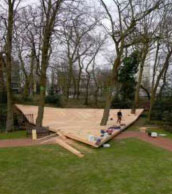
For five months, The Commons Platform and The Commons Tower reactivate the once-prevalent form of joint ownership (as opposed to private ownership or state ownership) that barely exists today.
The joy that radiates from the face in this photograph seems absolute. It also seems so rare. The smiles of my acquaintances lack such complete joy. Happiness does not define their constant state of being.

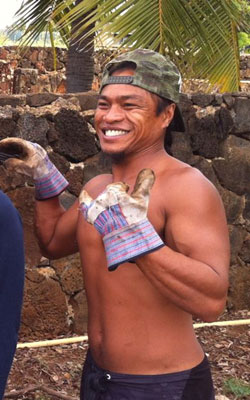
Superflex, Critical Art Ensemble, and Beehive Collective are among the many eco artists who prefer working as members of a team, instead of producing art in a solo fashion. Their implicit rejection of individualism may signal the culture-wide shift that is required to halt humanity’s rampage against the planet Earth. Demonstrating an alternative to the entrenched, culture-wide adoption of individualism would constitute a revolution. This cultural bias exists in the form of an assumption that each human is a separate self, driven by selfish impulses.
Systems thinking, food webs, hydrologic cycles, biological decomposition – the mutuality of these concepts is core to solving the planet’s myriad deficiencies and excesses. Since they all present shared conditions, sharing seems required to erect solutions.