Marjetica Potrc: Who Stole the Common from the Goose?
Marjetica Potrc is currently working on "The Commons Project". It occupies two unused sites in The Hague, Netherlands. One is a small remnant of a former dune forest. It is the kind of natural environment that has been held in common for centuries. The other is an empty tower that is considered a monument of modernist architecture. It was built by the architect J. J. P. Oud in 1969. The project creates an equivalence between unused land and vacant buildings. Not only do these sites have the same size as the footprint, but they are both 'unowned', and therefore eligible for being held 'in common'.
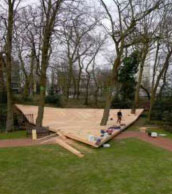
For five months, The Commons Platform and The Commons Tower reactivate the once-prevalent form of joint ownership (as opposed to private ownership or state ownership) that barely exists today.
The work expands Potrc’s commitment to maximizing the accessibility and sustainability of land in and around urban centers.
Here is some background:
The historic definition of the ‘commons’ that prevailed in Medieval England and persisted for hundreds of years. In its original form, the commons meant that land was held as an open, public asset. As such, peasants were allowed to conduct a form of subsistence farming known as ‘householding’. It assured the poor access to land they did not own for grazing small animals, collecting wild fruit and vegetables, and gathering firewood. The idea that one family could possess exclusive rights to a stretch of land was inconceivable to medieval peasants. Nonetheless, this age-old system started to crumble in the 1450s when wealthy farmers began encircling plots with fences and claiming it for their own private use. By the 18th century, half the common fields in England had been appropriated as private property. Even heaths, moorlands and highlands were enclosed. Then, between the 17th and 19th centuries, parliament began to back these un-deeded claims with the force of law. Peasants, stripped of their historic rights to the land, became dispossessed. Many people starved. Survivors were forced to seek alternative survival strategies.
It is no coincidence that England is known for two culturally transforming innovations. On the one hand the English spearheaded the ‘enclosure’ of common land by converting it into privately owned land. On the other hand, England became the epicenter for the establishment of industrialization.
In the process, the ‘commons’ that once provided the source of fuel, nourishment, culture, and community vanished. These conditions gave rise to the following limerick, and ‘the tragedy of the commons’.
The law locks up the man or woman
Who steals the goose from off the common
But lets the greater villain loose
Who steals the common from the goose