“I would not be found dead in this suit!”
“Speed up decomponsition??!! Is not my dead body decomposing fast enough for you??”
John Colbert extracted every ounce of the comedy from Jae Rhim Lee‘s Infinity Burial Suit, and never compromised the integrity of her pursuit. All this happened on Comedy Central on November 6.
The audience chuckled as they were introduced to a pragmatic and ethical alternative to conventional burial and cremation.
Joseph Beuys and David Hockney occupy the opposing responses to the massive scale of squandering and abuse by humans who have stripped water of its powers to heal and nourish. They provide vivid accountings of the contrasting ways artists can approach humanity’s relationship with the fluid that makes all life possible on Earth.
Once honored as the sacred source of creation among the ancient Babylonians, Pima Indians, Hebrews, Greeks, Aztecs, Egyptians, East Indians, Chinese, etc., the waters that course through contemporary lives has either been demoted to a formless, colorless, tasteless, and odorless liquid that flows predictably from a tap, or it looms into consciousness as a fearsome toxic menace. An arsenal of purifying treatments has been developed to decontaminate this former symbol of purity. They include filters, ultraviolet zappers, ionization, chlorination, etc.
WALTER DE MARIA died on on July 26. He was 77. Despite his penchant for constructiing monumental outdoor installations out of shiny geometric shapes and mathematical configurations.”The Lightning Field” epitomizes the grandeur of his reputation. DeMaria was known to be reclusive and uncomfortable with media attention. He seldom gave interviews, disliked being photographed, and often avoided participating in museum shows. Yet he became celebrated as “one of the greatest artists of our time” according to LA County Museum of Art director Michael Govan and many other influential contributors to contemporary art discourse. Govan described the singular quality of deMaria’s work as “sublime and direct.”
c
Meanwhile, Jerry Saltz summons a slew of ecstatic adjectives that seem more likely to appear in the work of a romanticist, not a minimalist like de Maria. He is particularly enraptured by The New York Earth Room. This permanent DIA installation fills the entire second floor of a large loft space in SoHo, NYC. This interior earth work consists of 250 cubic yards of black soil filling 3,600 square feet at a depth of 22 inches. Entry is barred by a sheet of glass only a few inches higher than the dirt. It weighs 280,000 pounds and has been exhibited in this location since 1980. Saltz declares the work fills him “with ecstatic quiet, and quivers of the surreal sublime, implacable force of nature, nobility of architecture, and acuteness of the human senses.”
“Cow bladder assembler for a Mardi Gras parade float.”
“Bat Cave Scavenger”
“Worm Dung Farmer”
“Sewer Inspector”
“Pig Farmer”
“Chick Sexer”
“Avian Vomitologist”
“Casino Food Recycler”
“Skull Cleaner”
“Dairy Cow Midwife”
All these professions have been featured on the television show, “Dirty Jobs” hosted by Mike Rowe since 2005. They are carefully selected to elicit ‘yuk’ sounds of disgust. Look closely, and you may note that each one contributes to the vitality and productivity of living systems.
Yun-Fei Ji may have accomplished a more encompassing depiction of the dire state of humanity than he consciously intended when he portrayed the villagers dislocated by the Great Gorges Dam. His mournful depictions of masses of forlorn and displaced persons seems to provide a glimpse at the toll that scientists are predicting will be shared by all humans.
Roy Scranton is a veteran who confronted the reality of his death throughout his tours of duty Iraq. But having returned a survivor of daily attacks has not provided him comfort and security. Scranton has diverted fear of his personal demise toward the demise of civilization itself. The danger, he claims, is self-inflicted, caused by humanities profligate and short-sighted greed.
Scranton quotes Admiral Samuel J. Locklear III, the commander of the United States Pacific Command, who states that global climate change is the greatest threat the United States faces. Upheaval from increased temperatures, rising seas, and radical destabilizatiom he believes, is more dangerous than terrorism, Chinese hackers and North Korean nuclear missiles.
We face the imminent collapse of the agricultural, shipping and energy networks that will result in a massive die-off in the biosphere. This includes human populations. If homo sapiens survives, it will inhabit an environment that is totally unlike the one we currently know.
on Wednesday, 6 November, 2013. Posted in
Artists,
BlogContemporary artists like Nicole Fournier, Critical Art Ensemble, Natalie Jeremijenko, and Steiner/Lenzlinger have extended the cultural role of gardens into the contemporary era. They are expanding a tradition that can be traced back to the World War I ‘Liberty Gardens’, Depression era ‘Relief Gardens’, and World War II ‘Victory Gardens’ that were all motivated by necessity. Wars, poverty, and economic depression convinced practitioners of all three kinds of gardens that grand strategic plans could neither liberate people from oppression, nor guarantee the safety and security of the populace. Because each of these historic events disrupted the production and distribution of necessities, masses of people were motivated to garden in order to ensure their own sustenance and to share scarce resources. The success of these movements demonstrates that horticultural skills were broadly disseminated throughout the population.
However, the popularity of these gardening movements did not survive after World War II ended. People who were no longer “digging for victory” began to associate gardening with disagreeable reminders of shortages, dangers, and conflicts. The public was easily lured away from growing their own food by the bevy of new packaged, canned, and frozen foods that suddenly appeared on store shelves. These new products were as time-saving and convenient as gardening was labor-intensive and difficult. Toiling in the soil faded as Pop culture boomed.
Masses of anti petroleum environmentalists watch as anti frackers attack anti nuc-ers and pro renewable advocates scramble to bolster the measely 1.2% of the U.S. annual energy production they currently supply. The debates that occupy journalists and politicians focus on production. There is hardly a mention of a strategy that will unquestionably and substantially minimize the havoc wreaked upon ecosystems associated with all these systems. Where are the advocates of efficiency and prudence????
The following flow chart presents estimated US energy use in 2009. It shows that a whopping 58% of the total energy produced in the US is wasted due to inefficiencies, such as waste heat from power plants, vehicles, and light bulbs. In other words, the US has an energy efficiency of 42%. The vast majority of energy comes from petroleum (37%), natural gas (25%), and coal (21%). These disturbing numbers were assembled by the Lawrence Livermore National Laboratory (LLNL).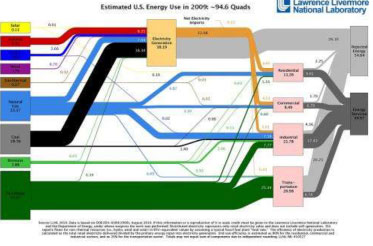
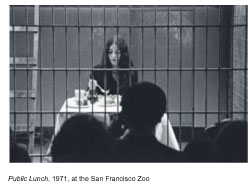
Besides sitting still and establishing a community farm beside a freeway in the 1970s, Bonnie Ora Sherk presented public performances in which she worked as a short-order cook in a donut shop and ate lunch in a cage at the San Francisco Zoo. The latter if featured in an exhibition, “Feast: Radical Hospitality in Contemporary Art” curated by Stephanie Smith, Deputy Director & Chief Curator at the Smart Museum of Art, The University of Chicago. Sherk explained the ecological and social implications of this performance in a wonderful interview conducted by Smith. It contains the following highlights:
Photographs of Public Lunch (1971) depict Sherk well-groomed and neatly dressed calmly eating an elegant meal. She is seated behind bars as a tiger evokes the opposite demeanor. It is devouring raw meat in the neighboring cage. Sherk timed the piece to coincide with the animals feeding schedule when many visitors congregate at these cages. They discovered that a female human animal was being fed like the non-human population at the zoo.
As Smith notes, by introducing the theme of human/animal relationships and communication, this solo meal blurred boundaries between human and animal behavior, public and private space, everyday life and spectacle, and biological versus cultural systems.
Red Earth provides one of many compelling examples of the ways artists are engaging Deep Ecology. Shai Zakai provides another approach. For 20 years she has been bonding with with plants, trees, roots, and rocks.
Zakai’s work earns the ‘deep‘ component of Deep Ecology by fostering communications with non-human entities. She comments, “Communication with the pulse of natural entities that surrounds us can be achieved by just being close to them. I talk about the power of ‘presenseshood’ where we can awaken our deepest intuition and see beyond.” Like Red Earth, Zakai awakens humanity’s intuitions. She believes that by listening to the intuitive connections that lie within our bodies, “we are able to regain our connection with and understanding of nature.” For Zakai, intuition is not imaginary, “it is a material energy like love, pain, or money.” Thus, intuition in her life is as tangible as a mountain.
Zakai’s work earn the ‘ecology‘ component of Deep Ecology by directing the insights and sensitivities gained through intuition toward environmental responsibility and concern. She explains, “If we join our intuitive forces, we can create a critical mass, which will influence the polluters and looters of our natural heritage, creating a change of the human perception about the world around us, a world which is a part of us.”

‘Influence’ is the topic of this blog which discusses a work of art entitled, “A Habit of Deciding Influence.” The subtitle of this work. “Pigeons from Charles Darwin’s Breeding Experiments,” reveals three forms of influence that inspired Brandon Ballengee to spend three years producing this handsome portfolio of prints. Two ‘influences’ originate with Charles Darwin. One is provided by the esteemed 19th century painter, Joseph Mallord William Turner.
