Beuys/Hockney – Art's Role in the Global Water Crisis
Joseph Beuys and David Hockney occupy the opposing responses to the massive scale of squandering and abuse by humans who have stripped water of its powers to heal and nourish. They provide vivid accountings of the contrasting ways artists can approach humanity's relationship with the fluid that makes all life possible on Earth.
Once honored as the sacred source of creation among the ancient Babylonians, Pima Indians, Hebrews, Greeks, Aztecs, Egyptians, East Indians, Chinese, etc., the waters that course through contemporary lives has either been demoted to a formless, colorless, tasteless, and odorless liquid that flows predictably from a tap, or it looms into consciousness as a fearsome toxic menace. An arsenal of purifying treatments has been developed to decontaminate this former symbol of purity. They include filters, ultraviolet zappers, ionization, chlorination, etc.
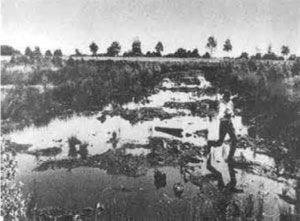
Joseph Beuys addressed humanity’s skewed relationship with the Earth’s waters in a 1971 when he performed “Bog Action.” The performance survives as a photograph depicting Beuys, fully clothed in his signature thick-soled shoes, dark slacks, white shirt, and felt hat, leaping joyfully into a murky brown bog. It requires no stretch of the imagination to realize why the word ‘bog’ is slang for ‘toilet’ in Britain. The squeamish ‘Yuk!” response is evoked because the thick, brown, boggy waters, that consist of decaying plant and animal matter, resembles the contents of a toilet. Beuys’s blissful leap reveals a contrasting attitude. To Beuys, the wetland was misjudged, maligned because it did not conform to aesthetic measures of beauty. But it functioned beautifully by maintaining the ecological health of the watershed. His immersion honored the valuable role that bog waters play in producing oxygen, sinking carbon, cleansing water, producing organic molecules, and supporting diverse plant and animal organisms.
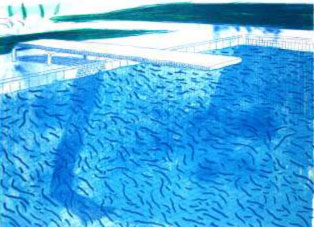
The public’s squeamishness regarding natural bodies of water factor into David Hockney’s popularity. Hockney earned renown in the 1970s by creating paintings depicting sylvan swimming pools, not ponds, lakes, or bogs. The water in these paintings is crystal-clear and cobalt-blue. It not only accounts for each painting’s visual appeal, it reinforces viewers’ preferences for water that is a product of engineering, not nature. Pool water is pumped through filters, treated with chemicals, and otherwise sterilized to remove the forms of organic matter that Beuys relished in the bog. It seems that the water that is desired today is ‘treated’ and ‘domesticated’, not ‘natural’ and ‘wild’. The waters in Hockney’s renowned paintings are stripped of their sacred power to foster health and growth. These works of art epitomize an era in which natural bodies of water are suspected of containing unsavory concoctions of effluents from sewage and industrial processes, and teeming with unidentified populations of micro organisms.