'Ecosystem' versus 'Landscape'
The innumerable admirers of Andy Goldsworthy are often baffled by the fact that his work provokes the ire and disdain of many eco artists. May I suggest that a primary reason that his work is problematic involves his futile attempt to unite two incompatable states of nature: wildness (of the sites in which he constructs his artworks( and cultivation (the formal control he asserts over the wild elements). The following provides a historic context for this controversy....
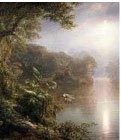
Frederic Church, (The River of Light), 1877 Vhttp://commons.wikimedia.org/wiki/File:El_Rio_de_Luz_%28The_River_of_Light%29_Frederic_Edwin_Church.jpg
Sublime beauty is not the only reason why the wilderness inspired the renowned Hudson River School painters in the 19th century. They also revered wilderness because it embodied the wondrous workings of nature and the sacred mysteries of God. Thomas Cole, Frederic Edwin Church, George Inness and many others watched with consternation as the Hudson Valley’s rugged wildness was leveled by railroads, paved by roads, rechanneled by mills, deforested by tanning industries, and tamed by farms. Their romanticized nostalgia epitomizes the art of the region in the early days of the Industrial Revolution.
Many contemporary artists are perpetuating these artists’ protest against the mindless pursuit of ‘progress’. However, the focus of their attempts to maintain the vitality of the nature is now referred to as ‘ecosystem’, not ‘landscape’. Landscapes address appearance. Ecosystems measure function.
Andy Goldsworthy typically has retained the attitude of landscape. Because his works privilege appearance (beauty), he retains the 19th century’s romantic nostalgia. He displays scant evidence of concern regarding the ability of the soils and waters to support healthy populations of humans, crops, and farm animals.
Contemporary eco artists are updating the Hudson River School of art by celebrating the functional productivity of the region’s ecosystems. Bountiful opportunities for sensual and aesthetic delight still exist, but these artists reconfigure ‘landscape art’ to reveal the concerns of the 21st century, just as Cole revealed those of the 19th century.
Their idealized landscape is provided by gardens and farms whose bountiful productivity does not compromise the health of soils, waters, air, insects, microbes, or wildlife.