Let us compare two works of art that both consist of large chunks of ice transported from the Arctic across continents and oceans to become viewable to a distant public. Coincidentally, both were created in 2006. Tavares Strachan’s version is entitled, “The Distance Between What We Have and What We Want”. The other was created by Olaffur Eliasson; its title is “Your Waste of Time”. The latter is part of ‘EXPO I’ that is currently on view at the Museum of Modern Art and P.S. 1 in New York.
Both works use solar power to maintain the frigid temperatures that keep the ice from melting in the alien environments to which they have been sent.
Strachan’s ice is a rectangular chunk. It is preserved in a glass-sided freezer just large enough to contain it.
Eliasson’s ice consists of irregular chunks installed in a gallery; the thermostat of the entire room is set to freezing temperatures.

Eliasson

Strachan
Can either justify the environmental costs of accomplishing these feats of transport and maintenance?
The Pleistocene era lasted 2.588 million years and ended approximately 12,000 years ago. It was succeeded by the Holocene era. Now, a new geological era has been added to the history of our planet. It is called the “Anthropocene” or “The Age of Mankind”.
This trailblazing scientific concept popularized by Nobel Prize winner Paul J. Crutzen, delves into a foreboding question: If nature is created by, shaped by, and controlled by humans, how do we differentiate “artificial” from “natural”? What are the ethical and ecological implications of the dissolution of this difference?
A new biography of Joseph Beuys has just been published. Unlike most texts, this one does not focus on Beuys as the hero of contemporary art and a radical political visionary. Instead, the author Hans Peter Riegel dispels the mythic idolization of Beuys by providing evidence that the man behind the myth was no saint.
Most curious about these revelations is the disclosure of the connection between Germany’s environmentalist Green Party and the Third Reich The biography reveals that Beuys volunteered for German military service in WWII. During the turbulent years following the war, his partners in promoting environmentalist causes were high-ranking Nazis.
Pedro Reyes can literally use the term ‘disarming’ to describe his ambitious projects to reduce the number of guns in circulation. He focuses on the Mexican territories where gun violence is an essential component of its drug-trafficking economy. The urgency of this initiative has been demonstrated in other sites since 2007 when he undertook “Palas por Pistolas”. Reyes comments that gun sales soared across the United States after the tragic shooting at Sandy Hook Elementary School in Connecticut that killed twenty children and six adults. “It is a sadly familiar response … After each massacre, whether a mass shooting in a Colorado movie theater or the attempted assassination of an Arizona congresswoman that killed several bystanders, Americans have bought guns at a higher pace than they did before the rampage.”
With these proofs of the importance of his efforts, he undertook another project, appropriately titled “Disarm”.
“Immortal Plastics” is part of a larger body of work by Marina Zurkow entitled “Necrocracy” (necro = dead, ocracy = governemnt). It consists of animations, prints, sculptures, a book, and food tasting events all geared to induce consumers to confront their personal relationships with hydrocarbons.

About ten years ago Maya Lin made a pledge to devote the rest of her career to awakening the public’s consciousness of environmental ills. This week she honored this noble commitment by opening two exhibitions at separate Pace Gallery locations. They share the title “Here and There”.
“Here” is exhibited at the 57th Street gallery in New York city; it features environmental issues related to the Hudson River. “There” is the exhibition at Pace’s London location; it features the Thames River and its ecological history. Instead of documenting the presence of nasty situations, Lin’s distincitive approach involves highlighting the absence of desirable conditions.

Does pessimisim outweigh optimism for artists who assume that the Earth is becoming so degraded that it will become uninhabitable?
Or does optimism outweigh pessimism when these artists pursue ways to expand the range of life to distant planets?
This intriguing conundrum applies to both Tavares Strachan and Andy Gracie.
Brandon Ballengee and Daniel McCormick are two artist/biologists who are not only concerned about aquatic populations, they are actively engaged in restoring these populations.
For decades Ballengée has been collecting deformed frogs, reptiles and amphibians in water ways that are dispersed throughout the world. Often his goal is to identify and document the deformities of their bodies. The ‘Malamp Project’, initiated in the late 1990s, brings public attention to this rampant trend and the extent to which our environment is being disrupted.

McCormick is dedicated to salmon populations that, despite the 50 million-year-long existence of salmon on Earth, are currently being decimated. His interventions resemble rescue missions more than celebrations. McCormick’s sculptures restore waterways so that they provide the conditions that salmon require to survive as they hatch, mature, and reproduce.

Marjetica Potrc is currently working on “The Commons Project”. It occupies two unused sites in The Hague, Netherlands. One is a small remnant of a former dune forest. It is the kind of natural environment that has been held in common for centuries. The other is an empty tower that is considered a monument of modernist architecture. It was built by the architect J. J. P. Oud in 1969. The project creates an equivalence between unused land and vacant buildings. Not only do these sites have the same size as the footprint, but they are both ‘unowned’, and therefore eligible for being held ‘in common’.
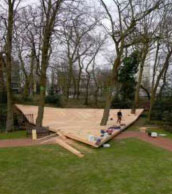
For five months, The Commons Platform and The Commons Tower reactivate the once-prevalent form of joint ownership (as opposed to private ownership or state ownership) that barely exists today.
Superflex, Critical Art Ensemble, and Beehive Collective are among the many eco artists who prefer working as members of a team, instead of producing art in a solo fashion. Their implicit rejection of individualism may signal the culture-wide shift that is required to halt humanity’s rampage against the planet Earth. Demonstrating an alternative to the entrenched, culture-wide adoption of individualism would constitute a revolution. This cultural bias exists in the form of an assumption that each human is a separate self, driven by selfish impulses.
Systems thinking, food webs, hydrologic cycles, biological decomposition – the mutuality of these concepts is core to solving the planet’s myriad deficiencies and excesses. Since they all present shared conditions, sharing seems required to erect solutions.