on Sunday, 15 September, 2013. Posted in
ArtistsThe innumerable admirers of Andy Goldsworthy are often baffled by the fact that his work provokes the ire and disdain of many eco artists. May I suggest that a primary reason that his work is problematic involves his futile attempt to unite two incompatable states of nature: wildness (of the sites in which he constructs his artworks( and cultivation (the formal control he asserts over the wild elements). The following provides a historic context for this controversy….
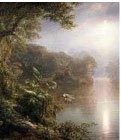
Frederic Church, (The River of Light), 1877 Vhttp://commons.wikimedia.org/wiki/File:El_Rio_de_Luz_%28The_River_of_Light%29_Frederic_Edwin_Church.jpg
on Saturday, 7 September, 2013. Posted in
Artists,
BlogThe planned expansion of the Bündner Kunstmuseum was exploited by Gerda Steiner and Jorg Lenzlinger as an opportunity to radically abandon museum installation protocols by filling the entire building with plants and crystals that will constantly change, undergoing their natural cycles of growth, death, and decay. The project opened on the longest day of the year and will close on the shortest. In between the wonderland the artists created will go wild!

Bundner Kunstmuseum

Steiner/Lenzlinger: National Park
The artist duo has redesigned the building from the basement up to the gables. The fixtures were torn out and used to build a mountain landscape. The rain water that falls on the roof is diverted and used to form streams inside the building. The windows are opened to allow sun, wind and rain to enter the architectural facility. An array of crops have been planted. They are attracting many kinds of animals.
The last century has witnessed a faceoff between two contrasting food-production schemes. One favored large scale industrial farming; its goal was to maximize yields and its methods depended on powerful mechanical technologies and applications of chemical herbicides, pesticides, and fertilizers. The other pursued the gardener’s intimate and nurturing interactions with plants and animals by emulating non-human strategies of growth and propagation. The farm straddles these opposing world views.
Industry, farm, and garden are society’s dominant forms of biological productivity. Because entire social, political, spiritual, environmental, and ethical philosophies are imbedded in each approach, gardening offers artists a powerful tool for waging subversive actions. Critical Art Ensemble provides one compelling example. Nicole Fournier provides another.
Evidence abounds of the health dangers associated with large scale agricultural production. I discovered the fallacy of assuming that artists who garden necessarily object to industrial agricultural production. In the early years of the 20th century, Karel Teige (1900 – 1951), a Czech artist, championed the ethical, technological, and aesthetic innovations that characterize modern industrial societies, and applied them to all human activities.
While discovering new and ingenious eco artists is a daily occurrence, these artists are typically young entrants into this burgeoning arena of cultural expression.
Today, however, my discovery turned my attention backwards by forty years. The artist’s name was Liz Christy (1950 -1985). She is credited with initiating this collective enterprise in the 1970s. Christy was an artist and graphic designer, not a gardener. Nonetheless, she rallied friends and neighbors to participate in her gardening projects. Her loyal band of rebel gardeners became known as the Green Guerillas. Their radical gardening procedures included ‘bombing’ barren urban lots with ‘seed grenades’ they fabricated from balloons filled with seeds and fertilizer.


Eco Visualization: Aesthetics for Sustainability is the title of an
April, 2013 article by Juliet Helmke exploring eco visualization, a genre of art that aims to educate and influence consumer behavior by presenting ecological data in a manner that can be ‘observed’ instead of ‘read’. The underlying assumption is that interpreting data through color and form, making it kinetic, or giving it physicality can greatly enhance its affecting power. Helmke mentions four artists featured in TO LIFE!: Joseph Beuys, Michael Mandiberg, HeHe, and Mierle Laderman Ukeles.
Visualization is an age-old component of fine art. In the past, artists have visualized the glory of the gods, the brutality of war, the wholesome life of the peasant, the corruption of politics, etc. It is the prefix ‘eco’ which defines the contemporary ‘focus’.

Energy generation is the focus of ambitious art projects by Amy Franceschini, HeHe, and SUPEFLEX, among others. Trends in actual energy production are confirming their innovative approaches are slowly inching away from ‘alternative’ into the ‘mainstream.
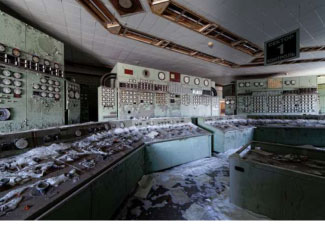
An article published today on Washington Blog announced that “Nuclear Power I Being Abandoned Worldwide”.
In addition, the nuclear decline correlates with renewable energy growth. The U.S. Energy Information Adminsitration announced, “In 2011, renewable sources of energy accounted for about 9.3% of total U.S. energy consumption and 12.7% of electricity generation. This is the largest share of energy consumption since 1950, and the largest share of electricity generation since 1984.”
Forty years ago, Bonnie Sherk launched an ambitious, precedent-setting mission to improve the sustainability and livability of communities sharing the Islais Creek Watershed in San Francisco, California.

Instead of burning out, Sherk’s fervor regarding this urban greening project seems to grow with each passing decade. Perhaps it is fueled by the project’s increasing and accelerating accomplishments. Residents in the eleven neighborhoods of the City that comprise the Islais Creek Watershed, including innumerable school children, have benefited from her efforts. Furthermore, the watershed itself is being improved by her interventions. These accomplishments are widely regarded. Yet there is another facet of her career that seems to merit more attention – Sherk also serves as an inspiring model for artists everywhere who share her commitment to energize their communities and restore their watersheds.
In the current issue of Hyperallergic, Maya Lin is being criticized for creating a work entitled, “Disappearing Bodies of Water: Arctic Ice” (2013), a sculpture of an ice flow carved out of pure white Vermont Danby marble. While her Vietnam Veterans Memorial (1980) is still praised for endowing two simple granite walls with sorrowful historic poignancy and healing power, this sculpure is being criticized as too literal and too slick.

There seems to be a perennial desire lodged within the human soul to sever human exclusivity and merge with other living entities. Multiple strategies exist for attaining such a unified world. One approach involves restraint and discipline, taming humanity’s savage and destructive impulses. Another approach fosters release from the inhibiting constraints of socialization. A third seeks unification with non-human forms of life. Terika Haapoja, for example, pursued unification with billions of invisible micro organisms that live within and upon the human organism.

Here is another perplexing potential sculpture that I must to add to my ever-expanding list of eco-art quandries and querries. It involves the development of procedures that enable people to ‘sculpt’ the tiniest ‘flowers’ in the world. This nano-technology could not only introduce a new sculptural medium, scale, and aesthetic into the history of art, it expands the domain of the exertion of artistic (and human) control. In this instance, the territory being occupied engages one of the great mysteries of the material environment – what accounts for nature’s complex and ever-varied shapes?

The process has been explored on the visible and tangible level by Steiner and Lenzlinger.
The tiny flowers in these images are colorized electron microscopic views of ‘nanoflowers’ – shapes that self-assemble. Each flower is approximately 50 micrometers in size, smaller than the width of a human hair. The ‘flowers’ develop in a beaker.