on Wednesday, 6 November, 2013. Posted in
Artists,
BlogContemporary artists like Nicole Fournier, Critical Art Ensemble, Natalie Jeremijenko, and Steiner/Lenzlinger have extended the cultural role of gardens into the contemporary era. They are expanding a tradition that can be traced back to the World War I ‘Liberty Gardens’, Depression era ‘Relief Gardens’, and World War II ‘Victory Gardens’ that were all motivated by necessity. Wars, poverty, and economic depression convinced practitioners of all three kinds of gardens that grand strategic plans could neither liberate people from oppression, nor guarantee the safety and security of the populace. Because each of these historic events disrupted the production and distribution of necessities, masses of people were motivated to garden in order to ensure their own sustenance and to share scarce resources. The success of these movements demonstrates that horticultural skills were broadly disseminated throughout the population.
However, the popularity of these gardening movements did not survive after World War II ended. People who were no longer “digging for victory” began to associate gardening with disagreeable reminders of shortages, dangers, and conflicts. The public was easily lured away from growing their own food by the bevy of new packaged, canned, and frozen foods that suddenly appeared on store shelves. These new products were as time-saving and convenient as gardening was labor-intensive and difficult. Toiling in the soil faded as Pop culture boomed.
Masses of anti petroleum environmentalists watch as anti frackers attack anti nuc-ers and pro renewable advocates scramble to bolster the measely 1.2% of the U.S. annual energy production they currently supply. The debates that occupy journalists and politicians focus on production. There is hardly a mention of a strategy that will unquestionably and substantially minimize the havoc wreaked upon ecosystems associated with all these systems. Where are the advocates of efficiency and prudence????
The following flow chart presents estimated US energy use in 2009. It shows that a whopping 58% of the total energy produced in the US is wasted due to inefficiencies, such as waste heat from power plants, vehicles, and light bulbs. In other words, the US has an energy efficiency of 42%. The vast majority of energy comes from petroleum (37%), natural gas (25%), and coal (21%). These disturbing numbers were assembled by the Lawrence Livermore National Laboratory (LLNL).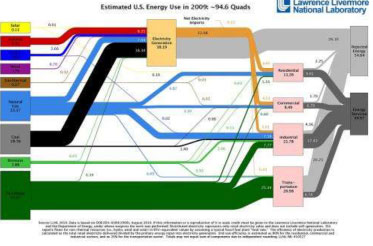
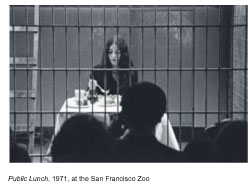
Besides sitting still and establishing a community farm beside a freeway in the 1970s, Bonnie Ora Sherk presented public performances in which she worked as a short-order cook in a donut shop and ate lunch in a cage at the San Francisco Zoo. The latter if featured in an exhibition, “Feast: Radical Hospitality in Contemporary Art” curated by Stephanie Smith, Deputy Director & Chief Curator at the Smart Museum of Art, The University of Chicago. Sherk explained the ecological and social implications of this performance in a wonderful interview conducted by Smith. It contains the following highlights:
Photographs of Public Lunch (1971) depict Sherk well-groomed and neatly dressed calmly eating an elegant meal. She is seated behind bars as a tiger evokes the opposite demeanor. It is devouring raw meat in the neighboring cage. Sherk timed the piece to coincide with the animals feeding schedule when many visitors congregate at these cages. They discovered that a female human animal was being fed like the non-human population at the zoo.
As Smith notes, by introducing the theme of human/animal relationships and communication, this solo meal blurred boundaries between human and animal behavior, public and private space, everyday life and spectacle, and biological versus cultural systems.
Red Earth provides one of many compelling examples of the ways artists are engaging Deep Ecology. Shai Zakai provides another approach. For 20 years she has been bonding with with plants, trees, roots, and rocks.
Zakai’s work earns the ‘deep‘ component of Deep Ecology by fostering communications with non-human entities. She comments, “Communication with the pulse of natural entities that surrounds us can be achieved by just being close to them. I talk about the power of ‘presenseshood’ where we can awaken our deepest intuition and see beyond.” Like Red Earth, Zakai awakens humanity’s intuitions. She believes that by listening to the intuitive connections that lie within our bodies, “we are able to regain our connection with and understanding of nature.” For Zakai, intuition is not imaginary, “it is a material energy like love, pain, or money.” Thus, intuition in her life is as tangible as a mountain.
Zakai’s work earn the ‘ecology‘ component of Deep Ecology by directing the insights and sensitivities gained through intuition toward environmental responsibility and concern. She explains, “If we join our intuitive forces, we can create a critical mass, which will influence the polluters and looters of our natural heritage, creating a change of the human perception about the world around us, a world which is a part of us.”

‘Influence’ is the topic of this blog which discusses a work of art entitled, “A Habit of Deciding Influence.” The subtitle of this work. “Pigeons from Charles Darwin’s Breeding Experiments,” reveals three forms of influence that inspired Brandon Ballengee to spend three years producing this handsome portfolio of prints. Two ‘influences’ originate with Charles Darwin. One is provided by the esteemed 19th century painter, Joseph Mallord William Turner.

Since categorizations reflect entrenched cultural values, the significance of the conference reported in this blog lies far beyond intellectual curiosity and mental antics. Instead, it delves into the core values that define the ecological, economic, political, religious, and social practices that distinguish the contemporary era.
The symposium in question was co-organized by Terike Haapoja for the current Venice Biennale. It is titled it “A Counter Order of Things”. The ‘counter order’ refers to the search for alternatives to the Linnaeus tree of taxonomical knowledge that has long ruled the biological sciences.
The phrase is also a rif on Michel Foucault whose seminal book is entitled The Order of Things. Written in the 1960s, it asserts the limitations of standard taxonomies. Foucault replaces the reasoned order that accounts for Linneaus’s renown with a new system of thought that he calls the “exotic charm” that comprises a basis for post-modernist thought.
As proof that artists who are activists regarding environmental reform also tend to exhibit a fervent desire to reform social spaces as well. They apply the terms ‘safe’, ‘true’, ‘clean’, ‘sustainable’, and ‘productive’ to multiple contexts. Consider the Experiments in Extra-Institutional Education that Michael Mandiberg organized with several collaborators.
Last spring he organized a colloquium exploring experiments in educational stratagies and philosophies. The project gathered the prime-movers whose creativity is inspired by the objection to schools in which desks are lined up in rows, bells regulate the march of students through halls, and classroom content is dictated by remote authorities.
The popularity of the initial event has spawned this autumn’s Experiments in Extra-Institutional Education seminar series. 
A life-ambition was fulfilled last weekend when I visited Herbert Bayer‘s renowned Mill Creek Earthworks Project for the first time. While every description mentions its location at the confluence of two rivers, none reveal that it is also situated in the confluence of several highways. They literally exist as ‘high’ ways because this renowned water restoration project lies far below the thoroughfares on two sides, an apartment complex on the third side, and a distant view of the town on the fourth. The pure shapes of a refined artistic sensibility exist in the midst of ceaseless traffic and banal architecture.


Globalism is apparent in world music, world cups, world wars, world politics, world premieres, world travelers, and the World Wide Web. It is less apparent in paperclips, shoe laces, peanuts, and combs.How can art portray the Earth as an elaborate, synchronized, self-regulating feedback mechanism? How can artists depict the global impact of local behaviors?
This complex scenario if revealed in a work entitled Herbarium of Origins (2006) by the Danish artist, Tue Greenfort. Greenfort focuses on the global consequences that accompany international trade by pairing an intended benefit (the importation of exotic fruits) with an unintended disadvantage (the introduction of invasive weeds).
12.00 Normal 0 false false false EN-US X-NONE X-NONE The positive outcomes that emerge from artistic failures is the focus of the essay in TO LIFE! exploring the work of two esteemed eco artists, Helen and Newton Harrison. The ‘failed’ works under consideration were all created in the 1970s. These renowned artists have continued to produce failed projects ever since. In a recent interview in Leaf Litter, an on-line newsletter published by Biohabitats,, they discuss the paradoxical relationship between artistic success and failure.
Newton states unequivocally, “I’m going to take issue with the whole idea of measuring success. I think it’s stupid.”
He and Helen explain that their relationship with ‘success’ is unconventional because it is unrelated to personal recognition or fame, “The work “works” when the community with whom we’re working understands the work and takes it up…It becomes the work of the community….When the community takes up the work, and the work is big enough, then our name is lost.”
 Helen and Newton Harrison – Sava River