Eduardo Kac: Transgenic Ethics
"I will never forget the moment when I first held her in my arms, in Jouy-en-Josas, France, on April 29, 2000. My apprehensive anticipation was replaced by joy and excitement. Alba -- the name given her by my wife, my daughter, and I -- was lovable and affectionate and an absolute delight to play with. As I cradled her, she playfully tucked her head between my body and my left arm, finding at last a comfortable position to rest and enjoy my gentle strokes. She immediately awoke in me a strong and urgent sense of responsibility for her well-being.”
These paternal sentiments, spoken by Eduardo Kac, were inspired by a baby, but the baby was not human. Alba is a live green fluorescent bunny
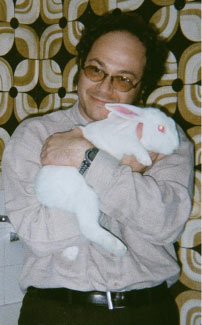
who has come to play a contested role in the history of recent art. She earned the designation as ‘art’ despite the fact that she was ‘created’ (conceived and delivered) by her rabbit parents, but she was altered, in utero, by Kac. He proclaims that his intervention transformed an albino rabbit into a fluorescent bunny that glows green when she is illuminated with blue light because a green fluorescent gene found in the jellyfish has been added to her DNA.
“GFP Bunny” is a transgenic artwork that combines aesthetics with social considerations. Kac e explains, “…what is important is the completely integrated process of creating the bunny, bringing her to society at large, and providing her with a loving, caring, and nurturing environment in which she can grow safe and healthy. …Transgenic art is not about the crafting of genetic objets d’art, either inert or imbued with vitality. …The word “aesthetics” in the context of transgenic art must be understood to mean that creation, socialization, and domestic integration are a single process.”
By adding respect and affection to technological genetic engineering protocols, Kac intends to manifest a new arena for the expression of ethical consciousness. It involves responsibility for the well-being of the living entities that humans have engineered into existence. He explains, “…the interpersonal contact with others is the unique relation of ethical responsibility. I create my works to accept and incorporate the reactions and decisions made by the participants, be they eukaryotes or prokaryotes. This is what I call the human-plant-bird-mammal-robot-insect-bacteria interface.”
If ecologists assign equal significance to all forms of life, and if environmentalists campaign for the well-being of all forms of life, Kac’s creative contribution is less the creation of a weird bunny, and more the articulation of today’s expanding realm of social concern.