Saraceno is Air-Borne
Tomas Saraceno creates inflatable airborne biospheres. These futuristic models for human survival may become essential if current environmental jeopardies continue to mount. The alternative ways of living he invents are adaptations of the morphology of soap bubbles, spider webs, neural networks, and cloud formations.
The complex geometries and interconnectivity that these habitations display seem neither to be art, architecture, technology, nor science. Perhaps even the nature of his art practice is futuristic. On December 9th of 2014, his "Museo Aero Solar" landed in Toulouse as part of a symposium on the new “Anthropocene” era.
Saraceno proposed it as an Anthropocene Monument. The solar sculpture flies by capturing the short waves of the sun during the day, and infrared waves from the Earth at night. This lighter-than-air monument is capable of riding thermals, vortices and convection currents. As it responds to these atmospheric forces, the structure actually takes the “shape” of the atmosphere.
I
In Toulouse, guided tours of the Museo Aero Solar introduced visitors to a new conception of space and energy. Constant maintenance is required to keep the monument in the air. People follow the unwieldy sculpture, capture it when it descends, and relaunch it when the sun shines. Saraceno says he wants to cultivate an “ethos of care, hospitality and an elemental sensitivity crucial to the potential of a “good” Anthropocene.”
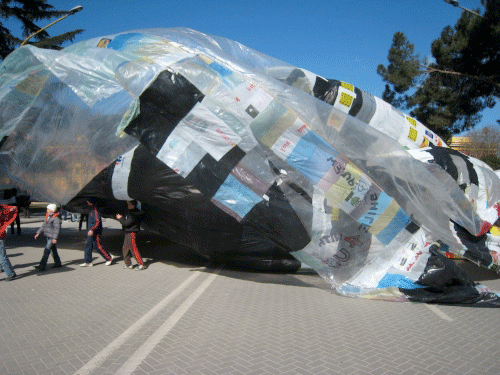
This floating monument models a survival scheme that is exclusively solar powered. It demonstrates how future societies might exist according to the rations of sun-Earth-air relationships. According to this scheme, people would drift above the surface of the Earth in a structure that resembles clouds instead of boxes. This Museo is a sphere, a shape that is natural to any object created out of the air.
The Museo is constructed out of hundreds of used plastic bags and various packaging papers. Its components were collected in Sharjah (United Arab Emirates), Isola (Italy), Medellín (Colombia), Lyon (France), Rapperswil (Switzerland), Tirana (Albania), Ein Hawd (Israel), Minneapolis (USA) , Bonames / Kalbach (Germany) Carmignano / Montemurlo (Italy) and Arnsberg (Germany). At each step, visitors cut and taped bags donated by them. In this manner, the Museo grows larger at every stop. Because it manifests the inventiveness of local inhabitants, this outlandish experimental technology is an embodiement of collective, do-it-together technology that may prove to be perfectly synchronized with future circumstances.