Cross-Species Togetherness
There seems to be a perennial desire lodged within the human soul to sever human exclusivity and merge with other living entities. Multiple strategies exist for attaining such a unified world. One approach involves restraint and discipline, taming humanity’s savage and destructive impulses. Another approach fosters release from the inhibiting constraints of socialization. A third seeks unification with non-human forms of life. Terika Haapoja, for example, pursued unification with billions of invisible micro organisms that live within and upon the human organism.

By honoring our interdependence with teeming populations of microbes, Haapoja reverses the widespread association of bacteria and fungii with disease, danger, and lack of sanitation.
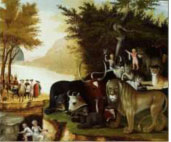
Art history provides other examples of such cross-species expansions of human experience. Two who come to mind also unify humans with living entities that are associated with fear and peril: Henri Rousseau (1844 – 1910) and Edward Hicks (1780-1849) seek unity with ferocious beasts of the jungle.
Rousseau gave visual form to such urgings when he painted “Dream” (1910). He depicted the lushness of exotic plants and the brawn of animals with incredible precision, although he never visited the jungle. Indeed, he never left France. His exotic jungle paintings are the fantasies of a city dweller, constructed from visits to the zoo, botanical gardens, postcards, and books depicting primeval realms. Perhaps the dream of the title belongs to the artist who envisioned an enchanted state of passivity, when wild beasts and humans relax into amicable relations and live harmoniously within dark, dense forests.
Edward Hicks was an American colonial folk artist best known for his Peaceable Kingdom paintings. He was inspired by a quotation of Isaiah’s prophecy in the Bible (Isa. 11:6): “The wolf shall also dwell with the lamb, and the leopard shall lie down with the kid; and the calf and the young lion and the fatling together; and a little child shall lead them.” In his paintings, wild animals appear domesticated and kindness has replaces savage impulses. Egotistical, greedy, lustful impulses characterize humans as well as animals. Within the Peaceable Kingdom, both have been tamed. The magical light bathing all the creatures manifests their sharing, kindness, and accord.